Dennis Costa Care · 2026
Dennis Costa Care
A multilingual site for a property-management company on the Costa del Sol — content plan, a local design language, and a static SvelteKit build that owners can actually find.
Opdrachtgever
Rol
Periode
Gepubliceerd
Leestijd
- Services, each with its own page
- 4
- Towns with local pages
- 8
- Long-form guides
- 5
- Languages, one codebase
- 3
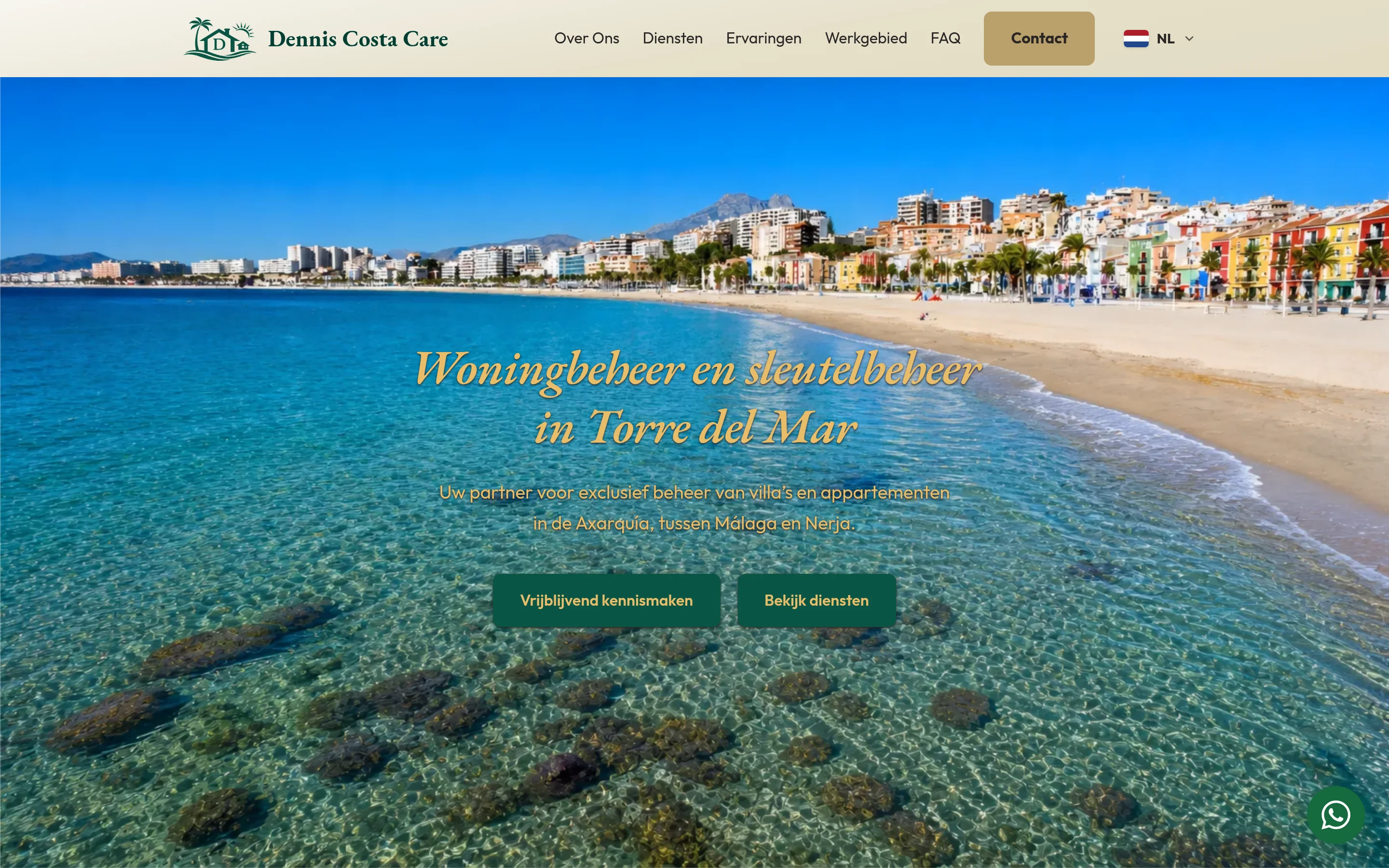
Dennis and Irma moved from the Netherlands to Torre del Mar and started Dennis Costa Care: keyholding, cleaning, guest reception, and linen service for owners of second homes along the Axarquía coast. Most of their clients live abroad for most of the year, so the website has to do a lot of the trust-building that a handshake would normally do.
The brief fit in a sentence: make it feel local, explain the services, and show up when an owner searches for help in their own town — in Dutch, English, or German.
Starting from the questions, not the pages
Before any layout existed, we wrote down what owners actually ask. Not “what pages should a company have”, but the real questions: who has my key, what does management cost, what happens to a house that stays empty for months, can I rent it out legally, and what should I do in winter.
That list became the site's structure:
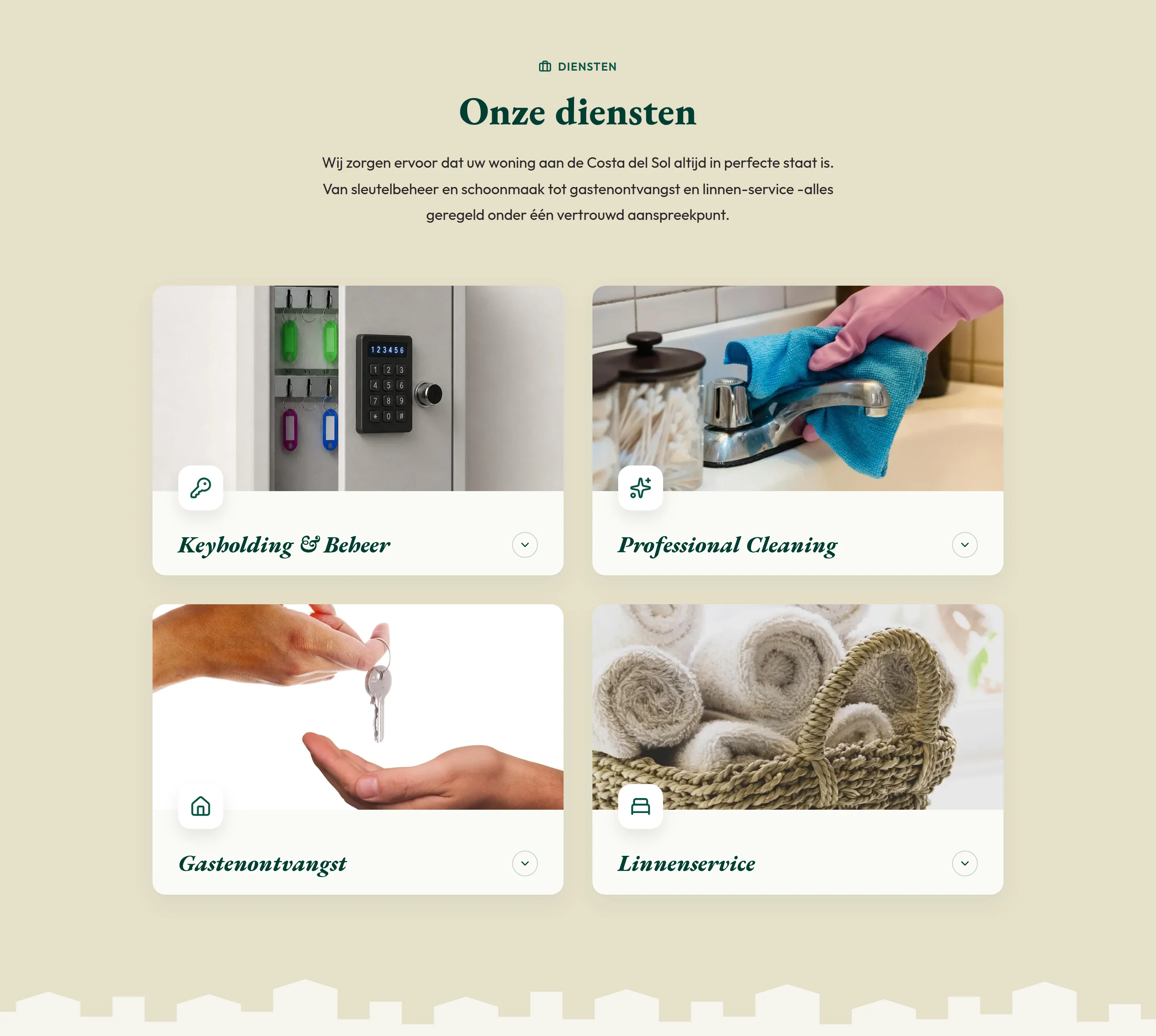
- Four services — keyholding, cleaning, guest reception, and linen service, each with its own page, price framing, and a list of what is included.
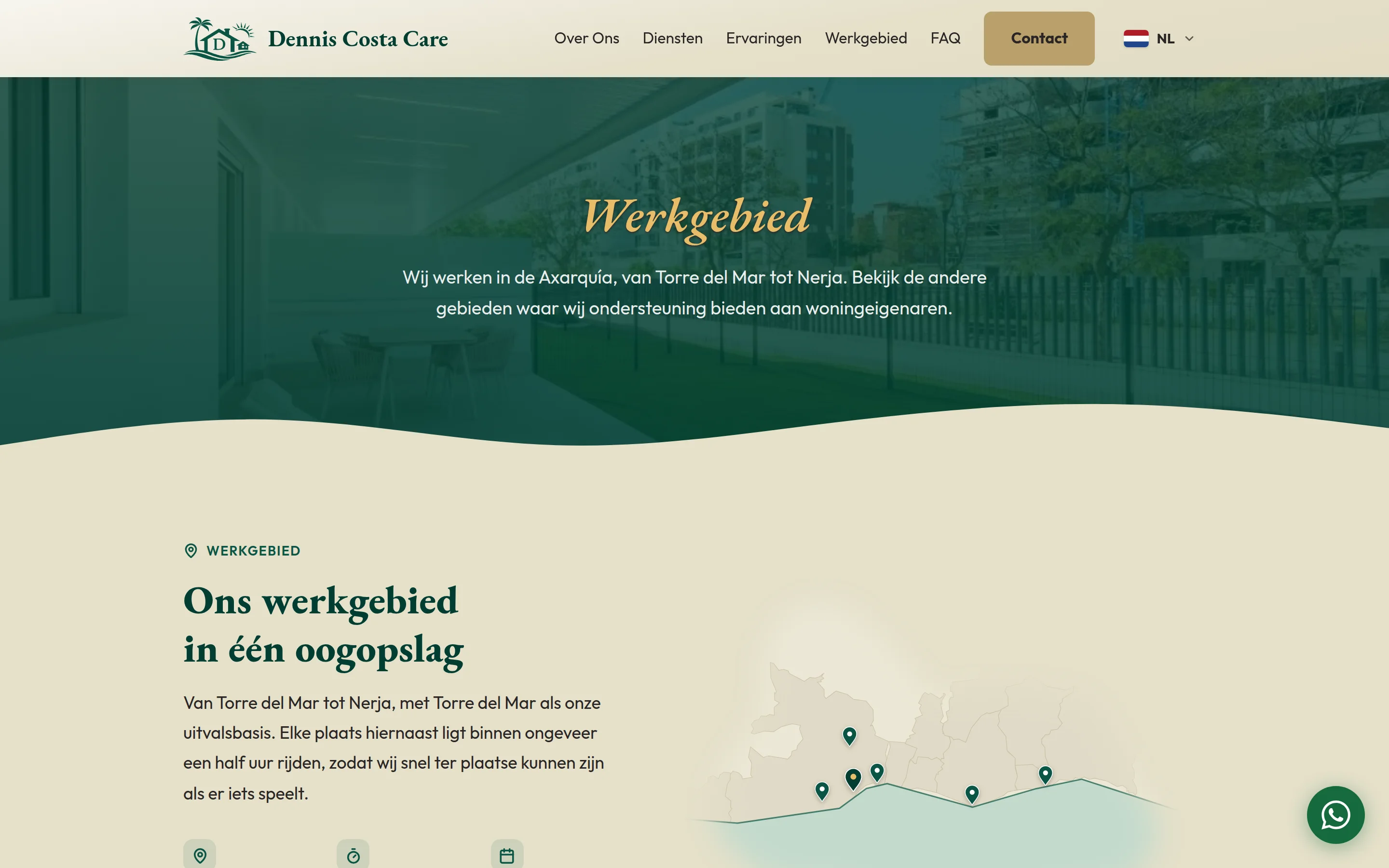
- Eight towns — from Chilches to Nerja, each with a page about what that specific area demands: humidity in Torre del Mar, salt air in Caleta de Vélez, water wells in Almayate, community rules in Chilches.
- Five guides — long-form answers to the research questions, from management costs to the VUT licence, written from daily practice rather than SEO templates.
Nothing is a dead end. Guides link to the service they relate to, service pages link to the towns where they run, and every page ends with a way to get in touch.
A design language from the place itself
The default for this kind of business is corporate blue. We went the other way: deep forest green and champagne ivory, drawn from the region's whitewashed towns, sea light, and warm sand.
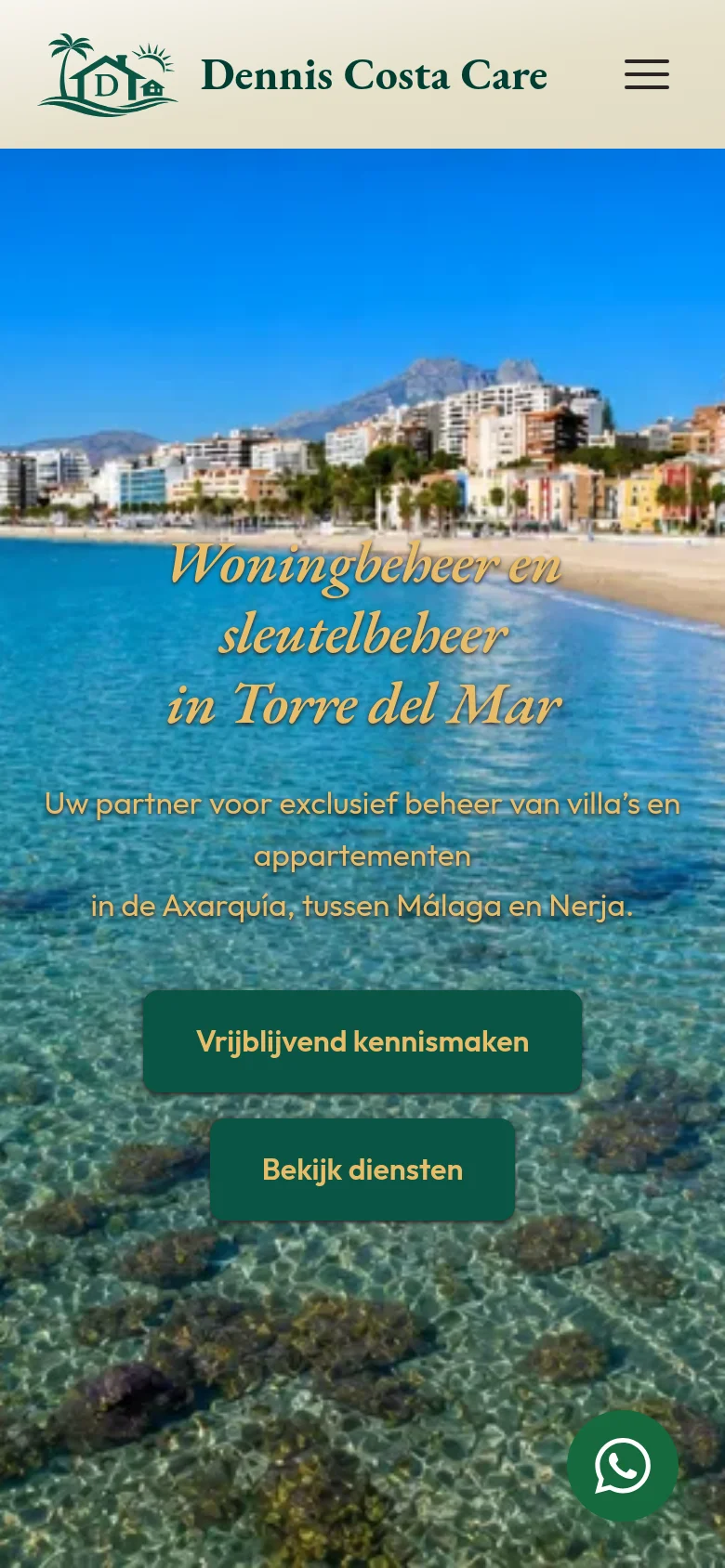
Headings are set in EB Garamond — a serif that reads like hospitality rather than software — and body copy in Outfit. Photography is local: the beach at Torre del Mar, the lighthouse, the homes themselves. Wave-shaped dividers separate sections, echoing the coastline.
Motion is there, but it stays out of the way. GSAP reveals sections once as they enter the viewport, Lenis smooths the scroll, and everything switches off under prefers-reduced-motion. The buttons lift a few pixels on hover; that is the extent of the show.
Three languages, one codebase
The audience is Dutch, English, and German — often in the same week. Every page exists in all three languages, with locale-specific URL slugs instead of a shared path: /diensten/schoonmaak/, /services/cleaning/, and /leistungen/reinigung/ are the same page in three markets. The language switcher keeps you on the page you were reading, and hreflang clusters tell search engines which version belongs to which audience.
Under the hood it is a small, custom i18n layer over nested message catalogues. Services, towns, and guides are catalogues too, so adding a new town is one entry plus translations — not a new page component. Titles, descriptions, and structured data are generated per locale.
| Language | The same cleaning page |
|---|---|
| Nederlands | /diensten/schoonmaak/ |
| English | /services/cleaning/ |
| Deutsch | /leistungen/reinigung/ |
Static, fast, findable
The site is a SvelteKit build with adapter-static: every page is prerendered, photos ship as optimized WebP variants, and the interactive pieces — menus, accordions, and the scroll animations — hydrate on top of that.
Search visibility was part of the design, not an afterthought:
- LocalBusiness schema with
areaServedfor the whole coast, plusServicenodes for the four services. - FAQPage and Review nodes built from the questions and testimonials that are actually visible on the page — no invented rating data.
- Article schema for each guide, with published and updated dates.
- A sitemap and robots setup that mirrors the locale and slug structure.
The town pages carry unique copy — drive times, the local municipality, what actually goes wrong in that area — because templated location pages with a swapped name are a scaled-content risk. Each town earned its own text or it did not get a page.
The small things
A few details that make the site feel like a local partner rather than a brochure:
- The hero remembers the area you looked at and starts the location line on your town.
- WhatsApp is available as a floating button, a QR code, and a link in every call to action.
- The contact form asks for a phone number as well as an email, because that is how this audience actually communicates.
- Terms and conditions are written out in plain language on the site, not hidden in a PDF.
What I'd take forward
Write the content plan before the design. This site's structure is essentially the list of questions owners ask, in the order they ask them, and the design only had to make that list feel like the coast.
Locale-specific slugs are worth the bookkeeping. Static builds make performance and SEO pleasantly boring. And client websites are never finished — the guide section keeps growing as new questions come in.